

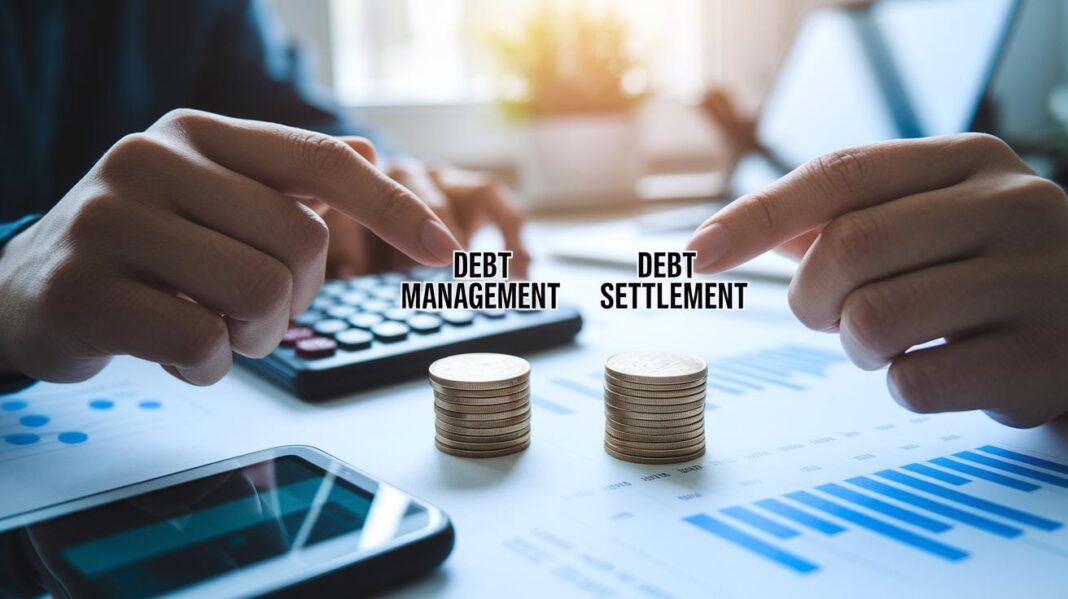
Ever wonder if lowering your interest might cost you hidden fees? Debt management and debt settlement are different choices that affect your credit in different ways. With debt management, you merge all your debts into one regular monthly bill while still building a good credit record. In contrast, debt settlement pauses your payments, which can add extra charges and fees over time. This guide explains both options so you can decide which one works best for your financial needs.
Quick Guide to Debt Management vs Debt Settlement
Debt management and debt settlement are two different ways to handle debt issues. With debt settlement, for-profit companies step in to speak with your creditors and try to lower the total amount you owe. While they negotiate, you might be asked to pause your regular payments. This break can lead to late fees, extra charges, and even hurt your credit score. Settlement fees usually run about 15% to 20% of the new, lower debt amount, and any canceled debt might create tax problems.
On the other hand, debt management plans are run by nonprofit credit counseling agencies. They combine your unsecured debts, like credit cards, into one monthly bill. The agency works with your creditors to get lower interest rates or waive some fees, all while you continue to pay on time. You may pay a small monthly fee, around $40 to $75, and you keep building a good credit record. Plus, these plans often include free lessons on budgeting and managing your money.
| Debt Settlement | Debt Management |
|---|---|
| Payments are halted during negotiations | You keep making your regular payments |
| High fees (15%-20% of reduced debt) | Small monthly fee ($40–$75) |
| Increased risk of credit score damage | Helps protect and repair your credit over time |
Your next step: Consider your finances and credit needs to decide which approach works best for you.
Debt Management Plans Explained

DMP basics have been covered before. Here, we dive deeper with a real-life example, show how agency services can differ, highlight common hurdles, and offer tips to choose a reliable nonprofit.
Take Sam, for instance. He joined a DMP with a nonprofit that offered flexible fees. His interest rate dropped by 3%, and he got monthly budgeting help. This example shows that some agencies do more than just merge your debts.
Other agencies might offer follow-up consultations and budgeting workshops, while some simply provide debt consolidation for a flat fee. That’s why it’s important to compare their services before you enroll.
Challenges you might face include uneven negotiation outcomes and gaps in communication. Ask these questions:
- Is the agency accredited by trusted credit counseling groups?
- Do they clearly disclose all fees before you commit?
- Can they share case studies or real client reviews that show their success?
| Tip | Description |
|---|---|
| Agency Accreditation | Confirm the agency is accredited by trusted credit counseling groups. |
| Transparent Fee Structure | Review clear fee guidelines and know what services are included. |
| Customer Reviews | Look for case studies and testimonials to see how others have benefited. |
Debt Settlement Strategies Overview
Debt settlement programs use for-profit companies to help lower your total debt by negotiating with creditors. Instead of stopping all payments, some smart strategies suggest making a small monthly payment. For example, one client kept paying $50 each month during negotiations, which helped protect their credit score while still letting creditors offer reductions.
Today, many negotiators recommend a blended approach. Ask for a written schedule that clearly states when you’ll resume full payments and shows the specific debt reduction you can expect. Make sure you get an update record each time the plan changes so you stay informed.
Settlement fees usually range from 15% to 20% of your reduced debt amount. If you stick to a small monthly payment, ask if your negotiator can lower or cap their fee. Also, check that any agreement covers how to handle possible tax bills from debt forgiveness.
Try this next:
- Get a detailed, written negotiation timeline.
- Keep paying a small amount each month to maintain your account activity.
- Ask if fees are adjustable during extended negotiations.
- Regularly check your credit report for any unexpected changes.
Following these steps offers a safer, more controlled path to getting your finances back on track.
Cost Comparison: Debt Management vs Debt Settlement

Debt management plans cost about $40 to $75 each month and let you keep making your usual payments. They help you avoid extra interest and fees. With debt settlement, you pay roughly 15% to 20% of your reduced debt, but you might have to stop making regular payments. This pause can lead to late fees, higher penalties, and tax issues if the forgiven debt is counted as income. Pick the option that fits your budget and minimizes extra costs.
| Aspect | Debt Management Plan | Debt Settlement Program |
|---|---|---|
| Cost | $40–$75 monthly fee | 15%–20% of reduced debt |
| Payment Method | Regular ongoing payments | May require pausing payments |
| Additional Risks | Avoids extra fees and interest | Risk of late fees, higher penalties, and tax issues |
Quick win: Add up your monthly budget and potential extra charges now to pick the plan that works best for you.
Credit Score Impact of Management and Settlement
If you choose a debt management plan, expect a short-term drop in your credit score. This happens when creditors close accounts and your credit use goes up as you consolidate unsecured debts. The good news is that paying on time, every month, can gradually rebuild your score. Regular payments and lower interest rates show a positive financial track record, which smooths out the initial dip.
On the other hand, debt settlement programs can have a deeper and longer-lasting effect on your credit. When you use a settlement program, you might stop making regular payments while a firm negotiates with your creditors. Missing payments and defaults will appear on your report, often leading to a significant score drop. It can take much longer to recover from these negative marks.
Try this:
- Check your credit report each month.
- Follow a clear repayment plan.
- Compare how each option affects your credit now and a year from now.
Eligibility Criteria for Debt Management vs Debt Settlement

Debt management plans are for people with unsecured debts like credit cards who can keep up with regular payments. If you have a steady income and are ready to work with a nonprofit agency to combine your bills into one easy monthly payment, a debt management plan could work well for you. While you pay off your bills, you'll also join free sessions on budgeting and smart money habits.
On the other hand, debt settlement fits best if you’ve missed payments and are under heavy financial stress. With debt settlement, you usually need to save a lump sum or make regular deposits into a special account before any negotiations with creditors start. This extra cash is used as a cushion during talks, so it requires a different kind of financial planning.
- Check if your income covers regular, on-time payments.
- See if you can set aside extra funds in a settlement account.
- Consider if you’re open to taking financial counseling.
Debt Management vs Debt Settlement: Key Takeaways
Think about how steady your income is, the kinds of debt you have, and how much risk you can take. A debt management plan works best if you make regular payments and want to protect your credit. On the other hand, debt settlement could lower your debt quickly, but it may come with extra fees and hurt your credit.
Here's a quick checklist:
- Check that you have a consistent income and a habit of making regular payments.
- Pick a plan that keeps your credit in good shape if your payments are steady.
- Get ready for extra risks and penalties if you need to cut your debt fast.
Your next step: Look over your budget and think about your risk tolerance. This will help you decide which method fits your payment habits and timeline for getting back on track.
Debt Management vs Debt Settlement: Real-World Scenarios

Let’s look at two borrowers with different debt challenges. In the first case, a borrower owes $15,000 on credit cards and enrolls in a debt management plan. They team up with a nonprofit credit counselor to lower interest rates and cut fees. By paying $350 a month, they not only reduce their debt but also slowly improve their credit score over 24 months. This steady plan shows how regular, fixed payments can help rebuild your credit over time.
In the second case, another borrower carries $25,000 in debt and chooses a debt settlement approach. This borrower stops making regular payments and builds a special account for settling the debt. After negotiating with creditors, they agree to cut the debt by 50%, meaning they end up paying $12,500 over 18 months. However, this faster debt reduction comes at a cost. The missed payments hurt their credit, and it takes much longer to recover their score.
Key differences are clear:
| Debt Management Plan | Debt Settlement |
|---|---|
| Pays a fixed amount every month | Saves up for a one-time settlement |
| Regular payments help boost credit | Missed payments slow credit recovery |
| Offers a clear, predictable timeline | Timeline is uncertain due to defaults |
Your next step: Check your personal budget and goals. If steady credit improvement is your aim, a debt management plan may be the way to go. If you prefer a quicker debt reduction and can handle a longer credit recovery, debt settlement might suit you better.
Finding Support: Nonprofit and Government Debt Relief Resources
When you're wrestling with debt, trusted nonprofits and government agencies can offer the support you need. Nonprofits like GreenPath Financial Wellness and the National Foundation for Credit Counseling (NFCC) deliver certified credit counseling, help manage debt repayment plans, and often provide free budgeting advice and financial education workshops.
Government programs also step in to help. For example, the Housing and Urban Development (HUD) agency offers housing counseling so you can better understand how debt impacts your living situation. Meanwhile, the Consumer Financial Protection Bureau (CFPB) offers a list of approved nonprofit counselors and easy-to-read guides on various debt relief options. This means you can get clear advice without worrying about high fees that for-profit companies sometimes charge.
Your next step:
- Look up reviews and check the group’s accreditation to ensure it is trustworthy.
- Review their fee structure and the list of services, so you know exactly what you're getting.
- Download free credit counseling guides offered by these agencies for extra help with managing your debt.
Taking these steps will help you decide which resource is the best fit for your needs.
Getting Started with Your Debt Management or Settlement Plan

This guide breaks down simple steps to choose the best way to handle your debt. First, pull your recent account statements. This helps you see exactly what you owe on credit cards and other unsecured debts, giving you a clear view of your financial situation.
Next, add up your total unsecured debt and create a monthly budget. This plan shows you how much you can comfortably put toward debt repayment each month. If you’re considering a debt settlement plan, set aside money in a separate negotiation account. This way, you'll be ready for any lump-sum payments during negotiations.
Try this:
- Collect your recent account statements to list all your credit card and unsecured debts.
- Total your unsecured debt and decide what percentage of your income you can use to pay it off each month.
- If you are exploring debt settlement, deposit funds into a negotiation account so you’re prepared when discussions begin.
Also, talk to a certified credit counselor. They can compare your options and provide practical advice on negotiations. Some counselors even offer a calculator that shows how long different repayment plans might take.
Finally, consider alternatives like balance transfers or consolidation loans before fully committing to one plan. This initial process helps you make a smart, well-informed choice.
Final Words
In the action, we reviewed how debt management vs debt settlement differs in key areas like cost, credit impact, and eligibility. We broke down DMP structure, settlement risks and shared real-world scenarios to help you choose the right resolution approach.
We also offered proven steps to gather your debts and work with trustworthy counselors.
Take a moment now to outline your next steps. This guide sets you on a clear path to rebuild your credit and regain financial control.
FAQ
Debt management vs debt settlement reddit
Discussions on Reddit show that debt management and debt settlement differ in approach, with users highlighting debt management’s structured, credit-friendly methods versus settlement’s riskier strategy of negotiating lower debt amounts.
Debt management vs debt settlement pros and cons
The pros and cons reveal that debt management plans offer structured repayment and credit benefits with fees, while debt settlement can lower overall debt but risks credit damage, late fees, and tax implications.
Debt management vs debt settlement california
In California, debt management plans are regulated nonprofit efforts that consolidate repayments, while debt settlement options can involve for-profit firms that may pause payments, risking additional penalties and credit issues.
Debt management vs debt settlement cost
Comparing costs shows that debt management involves fixed monthly fees ranging from $40 to $75, whereas debt settlement typically charges 15%–20% of the reduced balance plus potential additional fees and tax liabilities.
Debt settlement vs debt consolidation
The distinction is that debt settlement negotiates a lower overall balance by stopping payments during negotiations, while debt consolidation combines multiple debts into one new loan with a single monthly payment at a potentially lower interest rate.
Debt settlement companies
Debt settlement companies are for-profit firms that negotiate with creditors for reduced debt amounts, often requiring you to stop making payments during negotiations, which may lead to penalties and credit score declines.
Credit counseling vs debt settlement
Credit counseling involves nonprofit services that help set up structured debt management plans and offer financial education, while debt settlement focuses on negotiating lower debt balances but carries higher risks and potential credit damage.
Debt management plans
Debt management plans are organized by nonprofit credit counselors who consolidate unsecured debts into one payment, help lower interest rates and fees, and provide budgeting education to improve long-term credit health.
What is the difference between debt management plan and debt settlement?
The difference is that a debt management plan consolidates payments with nonprofit counseling support, while debt settlement involves halting payments to negotiate a reduced balance, increasing the risk of fees and credit harm.
What are the disadvantages of a debt management plan?
Disadvantages of a debt management plan include potential temporary credit score drops from account closures, monthly fees of $40–$75, and longer repayment periods, even though it offers structured support.
What is the difference between debt management and debt collection?
Debt management is a proactive, organized repayment plan often managed by nonprofits, whereas debt collection involves creditors or agencies actively pursuing overdue payments from borrowers.
What’s the difference between debt management and debt consolidation?
Debt management consolidates unsecured debts under nonprofit guidance into one monthly payment, while debt consolidation typically uses loans or balance transfers to merge various debts into a single repayment plan.